
Research Highlights
Research Interests
How do planets and their building materials originate — and what does this reveal about the origins of worlds?
My research aims to trace the physical and chemical pathways that lead from interstellar gas and dust to fully formed planetary systems. I study protoplanetary disks – rotating disks of gas and dust around young stars – which are the birthplaces of planets. By combining multi-wavelength observations from JWST and ALMA with self-consistent thermochemical models, I investigate how disk physics, chemistry, and evolution shape the diversity of planets that emerge.
A major component of my work is developing DiskMINT, an open-source modeling framework that couples disk physics and chemistry to interpret molecular line and ice observations. I use this tool to infer disk masses, chemical abundances, and ice compositions across disks of different stars – linking the raw materials of planet formation with the conditions that make them. I also have extensive experience in reducing and analyzing ALMA interferometric data. As part of the ALMA Large Program AGE-PRO, I served as a delegated co-I responsible for data reduction.
Topics I study include:
- Formation and early evolution of planetary systems
- Physics and chemistry of gas and dust in protoplanetary and circumplanetary disks
- Synergy of multi-wavelength observations (e.g., ALMA, JWST) for tracing the origins of planetary materials
I am also broadly interested in related areas, including the interstellar and circumstellar gas and dust, the formation and evolution of young stars, and the demographics of exoplanet population.
Recent Research Highlights
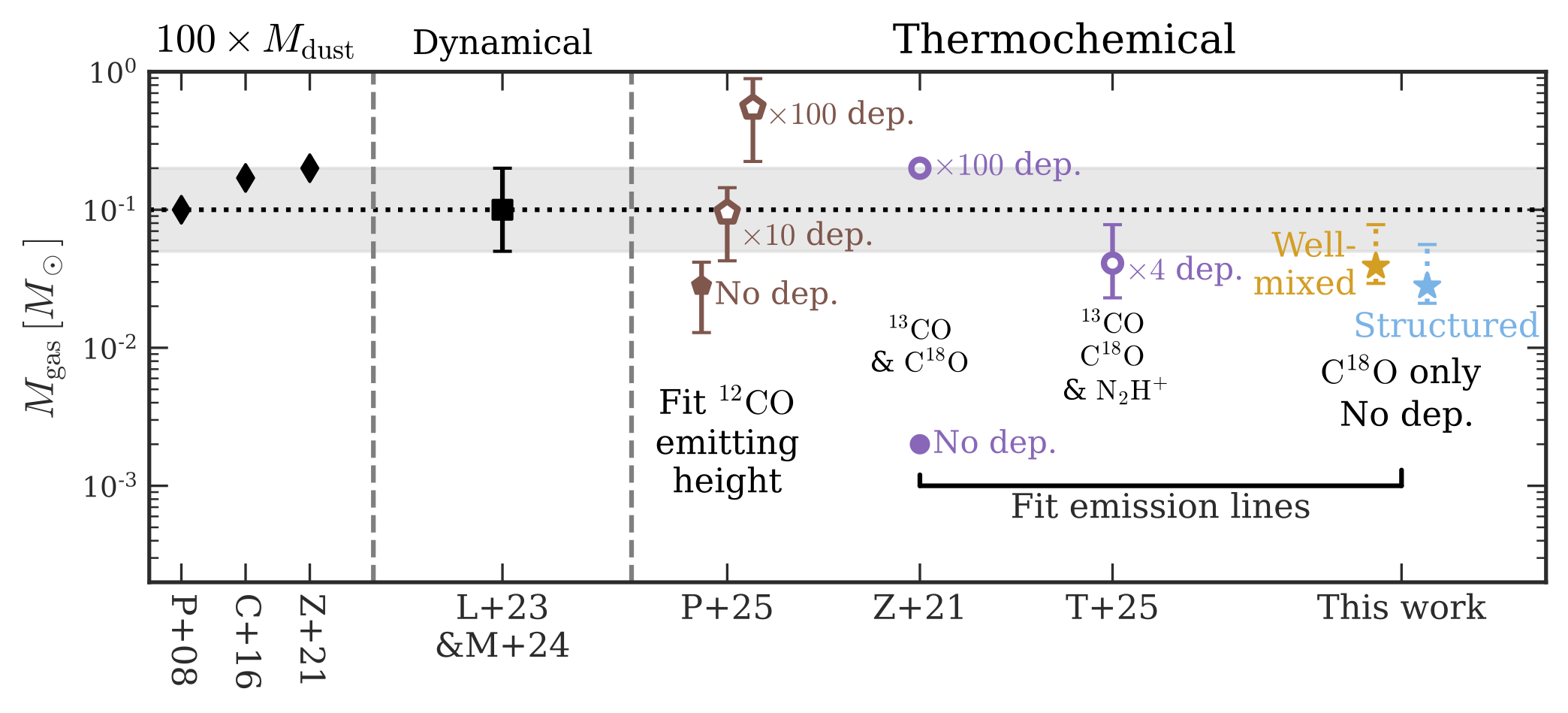
Dingshan Deng et al. 2025ApJ in press
DiskMINT (Disk Models for INdividual Targets) builds self-consistent thermochemical disk models. In this work, we extend DiskMINT to allow spatially decoupled gas and dust distributions. The code computes gas temperatures in thermal equilibrium with dust, solves vertical gas hydrostatic equilibrium, and includes key CO-chemistry processes: selective photodissociation and freeze-out with CO/CO2 ice conversion. We apply DiskMINT to the IM Lup disk—large and massive, yet previously inferred to show CO depletion up to 100 in thermochemical models. By jointly fitting the multi-wavelength SED, millimeter continuum, and C18O radial emission profiles, we obtain a gas disk mass of 0.02–0.08 M☉, consistent with dynamical estimates within the uncertainties. This approach enables robust gas-mass estimates in lower-mass disks where dynamical constraints are unavailable and in faint systems where rare species such as N2H+ are too weak to detect.
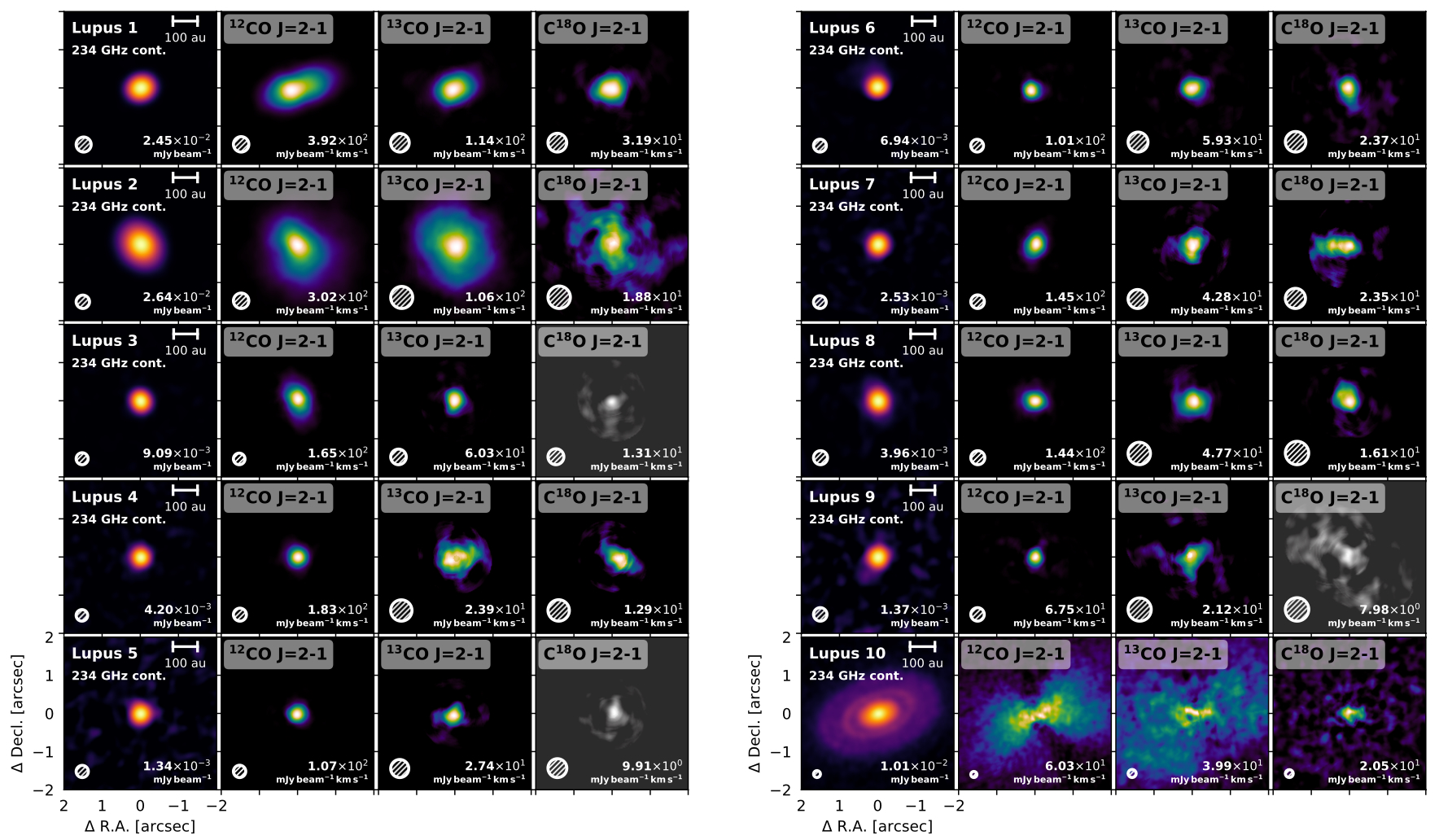
Dingshan Deng et al. 2025ApJ...989....3D
AGE-PRO (Atacama Large Millimeter/submillimeter Array survey of Gas Evolution in PROtoplanetary disks) is an ALMA Large Program dedicated to study the disk evolution by combining a sample of 30 disks in three different star-forming regions: young Ophicus, mid-age Lupus, and older Upper Sco. I led the data calibration and analysis on the 10 disks in the Lupus star forming region, and the key results are presented in the ApJ focus issue with AGE-PRO. III summarizing the Lupus disks. We find strong correlations of the CO isotopologue line fluxes with continuum flux densities, and a correlation between C18O J=2–1 and N2H+ J=3–2 fluxes, indicating similar CO abundances across this sample. We also show that the estimated gas disk masses in AGE-PRO agree with those in Ruaud et al. (2022).
Selected Publications
First Author and Key Contributions
- Deng, D., Gorti, U., Pascucci, I., and Ruaud, M., 2025, DiskMINT: Self-Consistent Thermochemical Disk Models with Radially Varying Gas and Dust – Application to the Massive, CO-Rich Disk of IM Lup, The Astrophysical Journal. In press.
- Deng, D., Vioque, M., Pascucci, I., et al., 2025, The ALMA Survey of Gas Evolution of PROtoplanetary Disks (AGE-PRO). III. Dust and Gas Disk Properties in the Lupus Star-forming Region, The Astrophysical Journal. ads
- AGE-PRO collabration (PI: Zhang, K.), including Deng, D. as co-I and one of the data delegate, 2025, The ALMA Survey of Gas Evolution of PROtoplanetary Disks (AGE-PRO). I-XII., The Astrophysical Journal, focus issue, AGE-PRO website
- Deng, D., Pascucci, I., and Fernandes, R., 2025, ysoisochrone: A Python package to estimate masses and ages for YSOs, The Journal of Open Source Software. ads, GitHub repo
- Xie, C., Pascucci, I., Deng, D., et al., 2025, JWST Captures a Sudden Stellar Outburst and Inner Disk Wall Destruction, The Astrophysical Journal, ads
- Deng, D., Ruaud, M., Gorti, U., and Pascucci, I., 2023, DiskMINT: A Tool to Estimate Disk Masses with CO Isotopologues, The Astrophysical Journal. ads, GitHub repo
- Pascucci, I., Skinner, B.~N., Deng, D., et al. 2023, Large Myr-old Disks Are Not Severely Depleted of Gas-phase CO or Carbon, The Astrophysical Journal, ads
- Huang, Q., Jiang, B., Deng, D., et al., 2023, Estimation of the Flux at 1450 MHz of OB Stars for FAST and SKA, The Astronomical Journal, ads, VizieR catalog
- Deng, D., Sun, Y., Wang, T., et al., 2022, Infrared Excess of a Large OB Star Sample, The Astrophysical Journal. ads, VizieR catalog
- Sun, Y., Deng, D., and Yuan, H., 2021, Precision of the CSST stellar radial velocities, Research in Astronomy and Astrophysics, ads
- Yuan, H., Deng, D., and Sun, Y., 2021, A star-based method for precise wavelength calibration of the CSST slitless spectroscopic survey, Research in Astronomy and Astrophysics, ads
- Deng, D., Sun, Y., Jian, M., et al., 2020, Intrinsic Color Indices of Early-type Dwarf Stars, The Astronomical Journal. ads